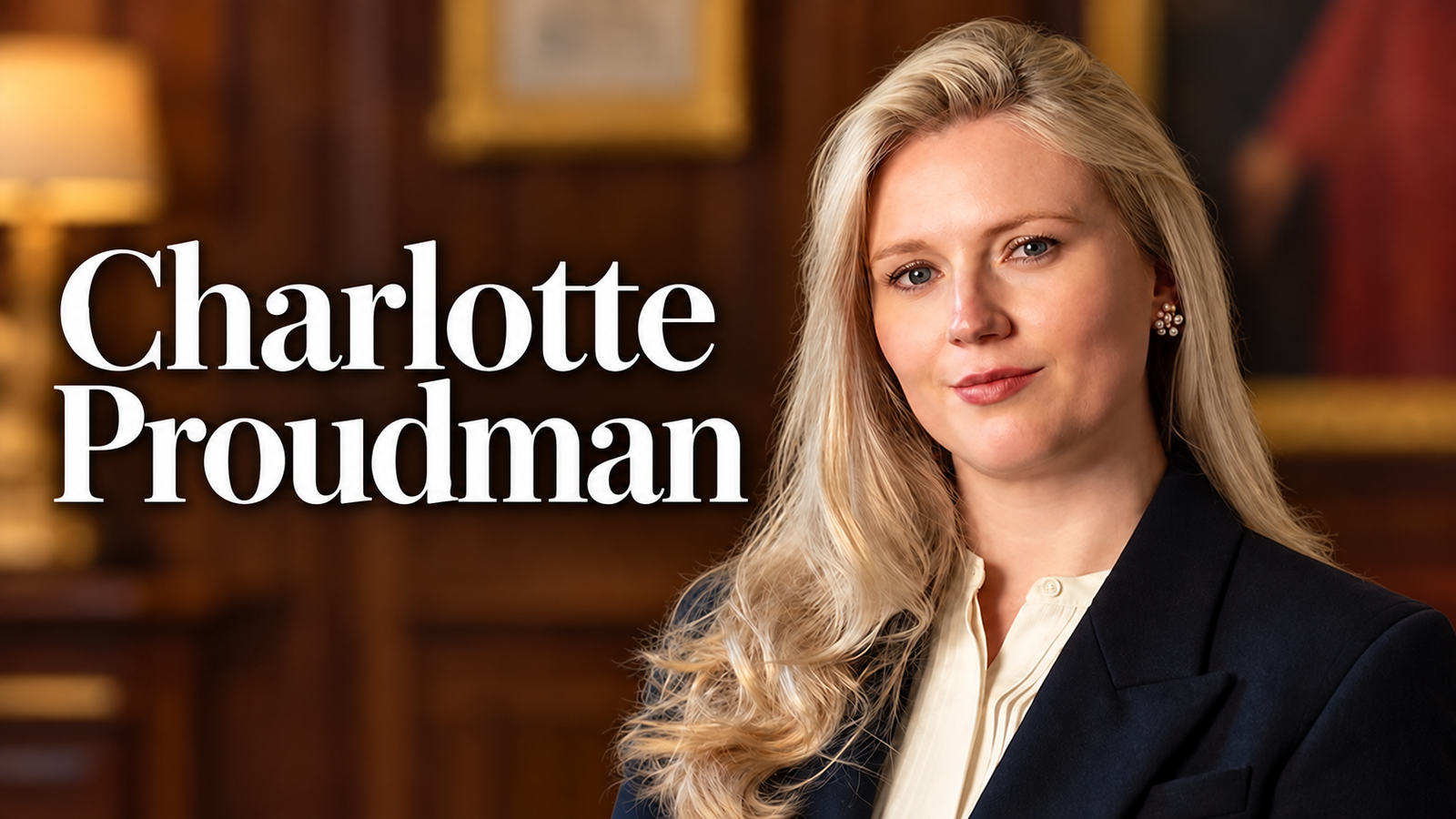
Charlotte Proudman: The Barrister Challenging Britain’s Family Court Culture
A clear look at her legal career, education, major cases, books, campaigns and current work at Proudmans.

Introduction
Charlotte Proudman is a British family-law barrister, academic, author and women’s-rights campaigner. She is known for representing women and children in cases involving domestic abuse, coercive control, rape allegations and child arrangements.
As of September 2026, she is the founder and in-house counsel of Proudmans, her specialist family-law firm. She also works as a Senior Research Associate at Jesus College, Cambridge, and runs the legal campaign group Right to Equality.
Quick Facts
| Fact | Detail |
|---|---|
| Full name | Dr Charlotte Rachael Proudman |
| Born | July 1988 |
| Birthplace | Leek, Staffordshire, England |
| Nationality | British |
| Profession | Barrister, academic, author and campaigner |
| Main legal field | Family law |
| Current position | Founder and in-house counsel at Proudmans |
| Academic role | Senior Research Associate at Jesus College, Cambridge |
| Organisation | Founder and director of Right to Equality |
| Called to the Bar | 2010 |
| Education | Keele University and University of Cambridge |
| Known for | Family-court cases, women’s rights and legal reform |
| First book | Female Genital Mutilation: When Culture and Law Clash |
| Latest book | He Said, She Said |
Who Is Charlotte Proudman?
She is a barrister who works mainly on family-law cases involving women, children and alleged domestic abuse. Her cases often deal with difficult questions: how courts assess coercive control, whether survivors can speak publicly and how judges handle patterns of abusive behaviour.
That work has brought attention.
Some people know her through court cases. Others first saw her name during the 2015 LinkedIn sexism debate. She later became a public critic of gender inequality inside the legal profession.
Right now, her work covers three connected areas. She represents clients, researches gender inequality and campaigns for changes in family law.
Early Life in Staffordshire
Proudman was born and raised in Leek, Staffordshire. She attended a local comprehensive school.
Her mother worked as an art teacher. At school, she studied art, photography, English and sociology. Sociology became a strong interest because it gave her a way to question social rules and power.
Law was already close to home.
Her father died when she was four. She later said that her mother spent years contesting his will and secured money for her. That experience made legal disputes part of her early life.
She initially considered becoming a solicitor in Staffordshire. Then work experience changed her mind. She met a young female criminal barrister and became interested in courtroom advocacy, quick thinking and the independence of life at the Bar.
Education and Legal Training
She studied law and sociology at Keele University. During her degree, she completed several mini-pupillages in Birmingham and Manchester.
She then moved to London for Bar training. It was a big change. She has spoken about feeling like an outsider because of her regional accent and non-elite educational background.
Still, she kept going.
She took part in pro-bono legal work, including work connected with IKWRO, an organisation supporting women and girls affected by forced marriage and honour-based abuse. A scholarship also allowed her to travel to Pakistan and research transnational forced marriage.
She was called to the Bar in 2010.
Before beginning pupillage, she completed an MPhil in Criminology at Queens’ College, Cambridge. She worked as a paralegal during this period to help cover her costs.
Her family-law pupillage began at Coram Chambers in 2011. She later moved to Mansfield Chambers.
Doctoral Research and Academic Work
Proudman completed a doctorate at King’s College, Cambridge. Her research examined British law and policy concerning female genital mutilation.
She also spent time as a visiting researcher at Harvard Law School and Berkeley Law School.
Her doctoral research later formed the base of her first book, Female Genital Mutilation: When Culture and Law Clash. Oxford University Press published it in 2022.
The book checks how UK law responds to FGM. It covers criminal law, family-court protection orders and the legal debate surrounding female genital cosmetic surgery.
She now holds the position of Senior Research Associate at the Intellectual Forum, Jesus College, Cambridge. Her official Jesus College profile says she researches and teaches gender inequality under the law.
Building a Family-Law Career
Family law was not her original plan. She first considered criminal practice.
Her pupillage changed that.
She found that family cases allowed her to work directly with people facing abuse, child-contact disputes and other serious problems. She began to focus on cases involving coercive control, rape, forced marriage and harmful patterns of behaviour.
In 2016, she joined Goldsmith Chambers. Her work there included private children cases, international family disputes and appeals.
Her court work soon gained wider attention. Several cases questioned how judges identify domestic abuse and how much weight should be given to patterns of control rather than single incidents.
Re H-N and Other Major Cases
One of her best-known cases was Re H-N and Others (Children) [2021] EWCA Civ 448.
Charlotte Proudman appeared as junior counsel for appellant mothers in parts of the case. The Court of Appeal examined how family courts should handle domestic-abuse allegations during child-arrangement proceedings.
The judgment asked courts to look at patterns.
That matters. Coercive control may involve repeated monitoring, isolation, financial pressure or emotional abuse rather than one obvious incident. The official Court of Appeal case record confirms the judgment was handed down on 30 March 2021.
Charlotte Proudman also represented former MP Kate Kniveton in proceedings linked to Griffiths v Tickle [2021] EWCA Civ 1882.
The dispute concerned whether a family-court judgment could be published with the adult parties named. A family judge had made findings of domestic and sexual abuse against former MP Andrew Griffiths.
The Court of Appeal allowed publication with the adults identified while protecting the child’s identity. The ruling became an important reference point for open justice and reporting from family courts.
The 2015 LinkedIn Sexism Debate
Proudman became nationally known in 2015 after publishing a LinkedIn exchange with solicitor Alexander Carter-Silk.
He had commented on her profile photograph. She described the message as sexist and argued that comments about a woman’s appearance were unsuitable in a professional setting.
Carter-Silk said it was meant as a compliment.
The exchange started a noisy public debate. Honestly, much of the coverage focused on her response rather than the wider workplace issue she wanted to raise.
Charlotte Proudman received strong criticism and online abuse. She also gained supporters who felt the incident showed how women’s professional standing can be reduced to their appearance.
The “Boys’ Club” Disciplinary Case
In April 2022, she published a thread criticising a family-court judgment. She argued that parts of the ruling appeared to minimise alleged domestic abuse and referred to a “boys’ club” attitude.
The Bar Standards Board brought five professional-misconduct charges. It alleged that the posts had misrepresented parts of the judgment and used seriously offensive language about the judge.
She denied wrongdoing.
Her lawyers argued that she was commenting on matters of public interest and exercising her right to free expression. They also claimed that she had been treated differently from male barristers who had used stronger language online.
In December 2024, a disciplinary tribunal dismissed every charge. The panel ruled that there was no case for her to answer.
This point needs to stay clear: she was not found guilty of professional misconduct.
Charlotte Proudman later sought more than £350,000 in legal costs. That application was refused in September 2025. She also said she had started separate Employment Tribunal proceedings alleging sex discrimination by the regulator. That allegation should not be presented as a proven legal finding.
The Garrick Club Campaign
Charlotte Proudman also criticised judges and senior lawyers who belonged to the Garrick Club while it excluded women.
In April 2024, a High Court judge was removed from one of her cases after concerns about apparent bias. His Garrick membership was one factor considered, together with other links involving the case.
The club voted to admit women in May 2024.
Many campaigners, lawyers and club members pushed for that change. Proudman was one of the public voices involved, but the result should not be credited to one person alone.
Right to Equality
She founded Right to Equality in 2022. Companies House records confirm that she became a director when the organisation was incorporated on 31 October that year.
The group campaigns for better legal protection for women and children. Its work covers family-court reform, domestic abuse, child removal, sexual violence and the treatment of mothers fleeing alleged abuse across international borders.
It also campaigned against the legal presumption that parental involvement will usually benefit a child.
In October 2025, the UK government committed to removing that presumption from the Children Act 1989. Yet the announcement said the change would happen when parliamentary time allowed. So, it is safer to call this a government commitment rather than say the law changed immediately.
Starting Proudmans
In 2025, she opened Proudmans, a specialist family-law firm.
She serves as founder and in-house counsel. The firm combines barristers and solicitors under one structure and handles child arrangements, divorce, financial disputes, domestic abuse, international cases and related civil claims.
Proudman Law Limited is authorised and regulated by the Solicitors Regulation Authority. The company number is 16430423, while its SRA identification number is 8012454.
The firm says it uses a trauma-informed approach. In simple terms, that means its lawyers try to recognise how abuse and trauma may affect a client’s memory, behaviour and ability to give evidence.
Books by Charlotte Proudman
Her first book was published in 2022.
Female Genital Mutilation: When Culture and Law Clash grew from her Cambridge doctoral research. It checks the limits of criminal law and the use of protective family-court orders.
Her second book arrived in 2025.
He Said, She Said: Truth, Trauma and the Struggle for Justice in Family Court mixes personal experience with accounts drawn from legal work. It argues that women and children can face disbelief, delay and harmful assumptions inside family proceedings.
The book also discusses forced marriage, child abduction, FGM, domestic abuse and court secrecy.
Awards and Professional Recognition
Her confirmed awards and listings include:
- Rising Star at the Women in Law Awards in 2020.
- Case of the Year for Re H-N and Others at the 2021 Family Law Awards.
- Inclusion in The Lawyer’s Hot 100 in 2022.
- Advocate of the Year at the Women and Diversity in Law Awards in 2023.
- Woman of the Year at the Women and Diversity in Law Awards in 2025.
- Highly commended for Barrister of the Year in 2025.
- Shortlisted for Woman of the Year and Advocate of the Year in 2026.
Awards show professional recognition. Still, the court judgments, published research and legal work give readers a better picture of her career.
Is Charlotte Proudman Married?
Reliable public sources do not clearly document a spouse or marriage.
For that reason, relationship claims found on profile sites should be avoided. Her public work, rather than unsupported personal details, is the safer subject for an accurate profile.
Charlotte Proudman’s Current Position
As of September 2026, she remains the founder and in-house counsel of Proudmans.
Charlotte Proudman also continues her Cambridge research role and her work with Right to Equality. Her public focus remains family-court safety, domestic-abuse evidence, open justice and legal accountability.
Her career is unusual.
Charlotte Proudman works inside the court system while openly criticising parts of it. That approach has brought praise, anger, disciplinary action and wide media attention. Yet her verified record rests on real cases, published books and continuing legal practice.
Final Thought
Charlotte Proudman is known because her work sits where law, abuse and public debate meet.
Charlotte Proudman has appeared in major family-law appeals, written two books and started both a campaign organisation and a regulated legal firm. She has also faced intense scrutiny for speaking publicly about judges and the legal profession.
Readers may agree or disagree with her arguments. The verified facts remain clear: she is an active barrister, Cambridge researcher, author and campaigner whose cases have contributed to serious discussion about domestic abuse and fairness in Britain’s family courts.
Frequently Asked Questions
Who is Charlotte Proudman?
Charlotte Proudman is a British family-law barrister, academic, author and women’s-rights campaigner.
What does Charlotte Proudman do now?
As of September 2026, she is the founder and in-house counsel of Proudmans and a Senior Research Associate at Jesus College, Cambridge.
Where did she study?
Charlotte Proudman studied law and sociology at Keele University, completed an MPhil at Queens’ College, Cambridge, and earned a doctorate from King’s College, Cambridge.
When was she called to the Bar?
Charlotte Proudman was called to the Bar in 2010.
What type of law does she practise?
Her work centres on family law, domestic abuse, coercive control, child arrangements and violence against women and girls.
What books has she written?
Charlotte Proudman wrote Female Genital Mutilation: When Culture and Law Clash and He Said, She Said.
Was she found guilty in the Bar Standards Board case?
No. A disciplinary tribunal dismissed all five misconduct charges in December 2024.
What is Right to Equality?
It is a not-for-profit organisation founded by Proudman that campaigns for legal changes affecting women and children.


